- Students analyzed a series of documents addressing the Gulf of Tonkin Resolution. They wrote group paragraphs answering the question, "Was the US planning on going to war in Vietnam before the Gulf of Tonkin Resolution?"
- Students viewed a lecture Vietnam I focused on the causes, courses, and consequences of the Vietnam war. Here are the lecture notes.
Thursday, April 28, 2016
The Vietnam War
Agenda 4/26-28:

Tuesday, April 26, 2016
Vietnam: Keylor Reading Questions
Keylor - pages 337-347
- Who was Ho Chi Minh? Explain his resistance to the French.
- In what ways did the US support France in the late 1940s?
- What happened at Dien Bien Phu?
- What were the conditions of the 1954 Geneva Accords?
- Why didn’t the US support the elections mandated in the Geneva Accords?
- What was SEATO?
- Who were the Viet Cong?
- What happened in the Gulf of Tonkin? What resulted from the incident?
- Make a simple graph of American troops in Vietnam over the course of the war.
- Identify the reasons for declining support for the war in the United States.
Monday, April 25, 2016
Origins of the Vietnam War
Agenda 4/18-22:
Vietnam Maps and Keylor Questions
- Students listened to the song Machine Gun by Jimi Hendrix while viewing a series of photos from the Vietnam War. After, they brainstormed key terms that they related to prior knowledge of the Vietnam War.
- Students read and interpreted The Man I Killed, by Tim O'Brien.
- Students completed maps of Southeast Asia and began to answer reading questions from the Keylor text.
- Students watch a clip from the film Vietnam: Televised War - Episode 1 - The Roots of War. I stopped the clip at Ho Chi Minh's Declaration of Vietnamese Independece
- Students participated in a simulation debating Vietnamese Independence in 1945, between French and Viet Minh representatives.
Vietnam Maps and Keylor Questions
Monday, April 18, 2016
The Korean War
Agenda 4/15:
- Students were introduced to a breif history of Korea, emphasizing the occupation of the Japanese from 1910 to 1945.
- Students completed maps of the Korean War. They used this timeline to help label their maps.
- Students read about the Korean War in the Keylor text (pages 327-333). They answered these questions and turned in their work.
Wednesday, April 13, 2016
The Course of WWI
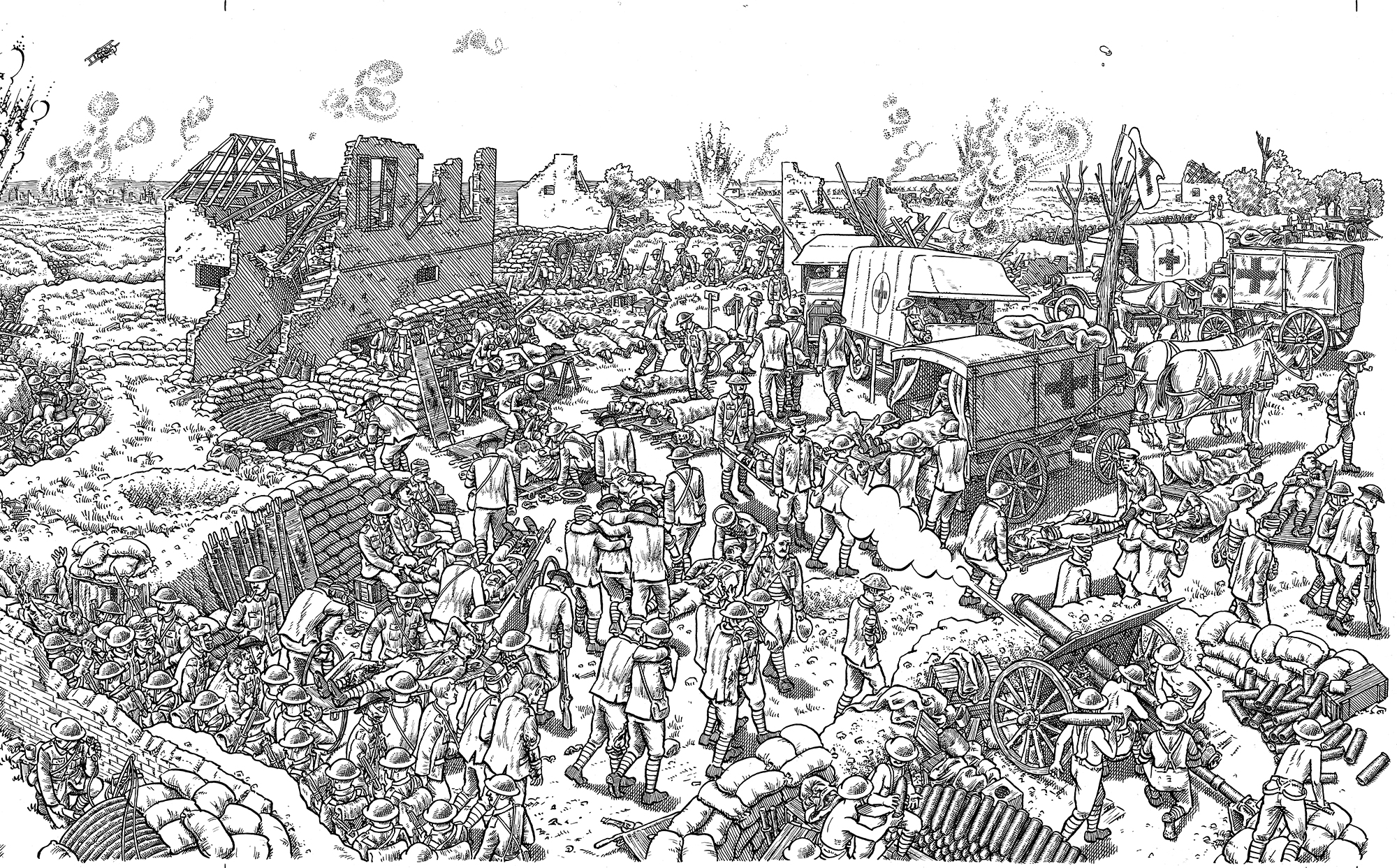
Agenda 4/8:
- Students examined panels from the book The Great War by Joe Sacco. Students looked for examples of total war.
- Students analyzed a series of documents. These included propaganda and critical works. They keep track on a graphic organizer.
- Students wrote a group paragraph answering the question: Analyze and assess how advancements in technology impacted the battlefield in WWI.
- Students listened to the song One by Metallica, based on the antiwar book Johnny Got His Gun
- Students watched clips from the film War Horse depicting changes in warfare during WWI.
- Students began viewing a slideshow on WWI [below].
WWI Slideshow:
War Horse - Cavalry Charge:
Wednesday, April 6, 2016
Causes of WWI
Agenda 4/5:
- I gave a lecture about the causes of WWI. Here are my lecture notes.
- Students completed pre-WWI maps of Europe in 1914.
- Students began reading Keylor pages 39-45, answering these questions:
- Who was responsible? Quote the text as evidence.
- Describe the political structure in Germany prior to WWI. Identify the strong and weak parties. Explain their strength and weakness.
HOMEWORK:
Keylor 39-45 - Prepare the above questions - DUE - Thursday 4/7
Monday, April 4, 2016
Types of Warfare
Agenda 4/1:
- Students read about different types of warfare in the 20th century. They organized the characteristics of these types of warfare on a concept map.
- Students then researched one of the course of one of the following conflicts, analyzing it in relation to the different types of warfare.
- The Falklands / Malvinas War
- The Spanish Civil War
- The Algerian War
- Nigerian Civil War
- Iran-Iraq War
- Gulf War
- Indo-Pakistan War
End of the Arab-Israeli Conflict
Agenda 3/28-4/1:
The Camp David Accords:
- Students read an article about the Camp David Peace Accords. Students read excerpts from the Camp David Accords, differentiating between the Framework for Peace and the Egyptian-Israeli peace agreement.
- Students participated in a text graffiti exercise. Students watched a clip from the film The 50 Years War [33:30 - 49:00].
50 Years War:
The Camp David Accords:
Tuesday, March 29, 2016
Wars, Wars, Wars (and some Peace)
Over the past few days students completed several tasks:
Yom Kippur War:
- Students learned about the 1967 Six Day War between Israel, Egypt, Jordan and Syria
- Students took a IB practice exam. The paper is document based and deals with the Arab Israeli conflict.
- Students learned about the 1973 Yom Kippur War
- Students worked in groups to make posters about the major conflicts between Arabs and Israelis between 1948 and 1973. Groups then presented their posters to class
- Students began learned about the 1978 Camp David Peace Accords.
1967 War:
Yom Kippur War:
Sunday, March 13, 2016
Palestine vs. Israel: Against the Wall
Good coverage from Vice News about where the conflict stands today.
Wednesday, March 9, 2016
QUIZ: Arab Israeli Conflict
There will be a quiz next week or after Spring Break.
Students will answer one of these prompts:
- Analyze cause, course, and consequence of the 1948 Arab - Israeli war.
- Discuss the origins of the Suez Crisis and its consequences for Britain and Egypt (Nasser)
- Assess the impact of the Sévres Protocol and its aftermath on international relations in 1956.
Students will also answer one of these prompts:
- Examine the aims and actions of the Palestine nationalist organizations between 1964 and 1979.
- Evaluate the extent to which the 1967 War can be considered a success for Israel.
- Evaluate the view that the Camp David Accords were a triumph for Egypt and a failure for Israel.
Monday, March 7, 2016
Palestinian Nationalism
Agenda 3/7:
- Students read about Palestinian Nationalist movements. Pages 74-78 in the Fraser text.
- I gave a presentation about Palestinian Nationalist groups [below]. Students took notes. This short video also gives a good background. Here are my lecture notes.
- Students began watching the documentary One Day in September about the group Black September and the taking of hostages at the 1972 Munich Olympics.
HOMEWORK:
Palestinian Nationalism:
Friday, March 4, 2016
Suez Crisis

Agenda 3/2:
- Students participated in a simulation about the the nationalization of the Suez canal. They debated the questions, "Should Egypt retain control of the Suez Canal?
- After I discussed the outcomes of the crisis [below].
HOMEWORK:
Wednesday, March 2, 2016
1956 Suez Crisis
Agenda 3/1:
- Students listened to a podcast about the 1948 war and how it is remembered in Israel. They took notes as they listened.
- I gave some background information about the Suez Canal crisis. Students took notes about the coup removing King Farouk, Gamel Abdel Nasser, non-alignment and the beginnings of the Cold War.
- Students read pages 60-68 in the Fraser text.
- Students read a speech by Nasser about the nationalization of the Suez Canal. They answered followup questions.
Monday, February 29, 2016
1948 War
Agenda 2/26:
- Students read the last six pages in Fraser, focusing on the events surrounding the 1948 war.
- Students watched a 10 minute clip from the film The 50 Year War, from 21:30 - 32:00.
- Students read an excerpt from the graphic novel, Footnotes in Gaza. It focusing on the plight of refugees.
- Students analyzed a series of documents and made maps of the results of the war.
HOMEWORK:
Chapter 1 Briefings - DUE - Now
Wednesday, February 24, 2016
Shifting British Support of Arabs and Jews
Agenda 2/24:
The 50 Year War:
Jewish Organizations:

- I reviewed the prior class, noting how the British had made a series of "incompatible promises" to Jews and Arabs in Palestine.
- Students took notes about a series of events and categorized them as helping either Jews or Arabs [below].
- In pairs they then read about the UN partition of Palestine from Jewish and Arab perspectives.
- To end, they watch the first 10 minutes of the documentary The 50 Year War to review.
HOMEWORK:
Intro and Chapter 1 Briefings from Fraser - DUE - Friday 2/26
"Incompatible Promises"
The 50 Year War:
Jewish Organizations:

Thursday, February 18, 2016
Palestine Before 1948
Agenda 2/18:
- Students analyzed a series of documents. They took notes using a t-chart. The chart was labelled: Statements in Support of Arabs | Statements in Support of Jews. Afterwards they answered several comprehension questions [see below]/
- Students watched a clip [approx. 9:00 to 30:00] from the film Promises and Betrayals.
HOMEWORK:
WWII / Holocaust / Schindler's List RAFT - DUE Monday 2/22
The Arab Israeli Conflict Chapter Briefing - Intro - DUE Monday 2/22
Tuesday, February 16, 2016
Arab Israeli Conflict
Agenda 2/16:
- Students began learning about the Arab Israeli conflict. They started reading from Fraser, The Arab-Israeli Conflict and were introduced to the chapter briefings they will complete for the first four chapters.
- Students labelled maps of the Middle East.
HOMEWORK:
Internal Assessment - DUE - Thursday 2/18
WWII / Holocaust / Schindler's List RAFT - DUE - Monday 2/22
Fraser Chapter Briefing - Introduction - DUE - Monday 2/22
Tuesday, February 9, 2016
Hitler Quiz - Feb. 11th
QUIZ PROMPTS: You will answer ONE of the following prompts.
- Evaluate the ways in which Hitler was able to consolidate his rule between 1933 and 1938.
- To what extent were the lives of ordinary Germans affected by Nazism? Identify at least two groups.
- In what ways did people resist Nazi rule? Provide examples.
HOMEWORK:
WWII/Holocaust RAFT - DUE - 2/22
Wednesday, February 3, 2016
The Road to WWII
Agenda 2/1-3:
WWI Photos:
- Students learned about opposition and resistance to the Nazi's [below]. Click here for teacher's notes.
- Students watched a lip from the film World at War [beginning at 22:00], taking notes about events in Germany that led to WWII. Students focused on: The Saar plebiscite, re-militarization, reoccupation of the Rhineland, Anschluss, The Munich Pact, the Nazi-Soviet Pact, and the invasion of Poland.
- Students then viewed a series of photographs [below], analyzing them and reading the captions aloud as a class.
- Students watched a short presentation about WWII and the Holocaust and began watching Schindler's List.
HOMEWORK:
IA - DUE - Feb. 18th
Opposition and Resistance to the Nazis:
WWI Photos:
Subscribe to:
Posts (Atom)