- What was life like in Cuba prior to the revolution?
- Explain the rule of Fulgencio Batista. What groups opposed him? Why?
Thursday, October 29, 2015
Cuba Under Batista
Reading Questions for Pearson Chapter 3, Section 1:

Wednesday, October 21, 2015
Mao: Foreign Policy
Agenda 10/21:
- Students worked in groups to investigate different moments in Chinese Foreign Policy. The made posters including Causes and Consequences of one of four policies: The Korean War, The Sino-Soviet Split, Sino-American Relations, and Tibet. Students used their Pearson text, Chapter 5, Section 3.
- Students began watching the documentary Mao Declassified.
HOMEWORK:
Mao QUIZ - Tuesday 10/27
Prompts for Mao quiz. The quiz will be given on Tuesday, October 27th. You will need to answer two of the following questions:
Prompts for Mao quiz. The quiz will be given on Tuesday, October 27th. You will need to answer two of the following questions:
- By what methods, and with what success did Mao Zedong try to eliminate domestic opposition?
- Examine the successes and failures of Mao Zedong’s economic policies.
- Examine the successes and failures of Mao Zedong’s domestic policies.
- In what was Mao Zedong able to create a cult of personality?
- Discuss the conditions that produced the Chinese Communist Party and the leadership of Mao Zedong.
- Explain one of Mao's foreign policies. Discuss causes, course, and consequences.
Friday, October 16, 2015
Mao: The Cultural Revolution and Foreign Policy

Agenda 10/16:
- Students finished studying documents about the Cultural Revolution
- Students wrote a two voice poem from contrasting viewpoints of individuals living through the Cultural Revolution.
- Students listened to a podcast about the Cultural Revolution and took notes.
Prompts for Mao quiz. The quiz will be given on Tuesday, October 27th. You will need to answer two of the following questions:
- By what methods, and with what success did Mao Zedong try to eliminate domestic opposition?
- Examine the successes and failures of Mao Zedong’s economic policies.
- Examine the successes and failures of Mao Zedong’s domestic policies.
- In what was Mao Zedong able to create a cult of personality?
- Discuss the conditions that produced the Chinese Communist Party and the leadership of Mao Zedong.
Wednesday, October 14, 2015
The Cultural Revolution
Agenda 10/14:
- Students interpreted propaganda posters. Students took notes on the different themes and messages in the propaganda.
- Students learned about the Cultural Revolution. They read an excerpt from the book Red Azalea and began interpreting a series of documents about the Cultural Revolution. They kept a list of people involved and their involvement.
- What was the purpose of the Cultural Revolution?
- Who were the Red Guard? Why did Mao turn from supporting them to opposing them?
- What were the costs of the Cultural Revolution?
- Explain the events surround the 1971 coup d’etat attempt.
- Who were the Gang of Four?
HOMEWORK:
Propaganda/Reality Posters DUE Tuesday 10/20
Thursday, October 8, 2015
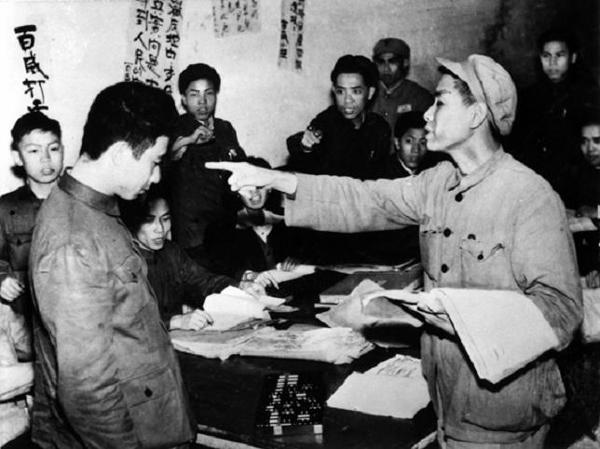
Mao and Opposition: The Antis Campaign
Agenda 10/7:
- Students read an excerpt from Mao: The Unknown Story about the Antis campaign and Mao's private lifestyle. They read, answered, and discussed these questions:
- What changes were instituted after the Communists took power?
- Who was the opposition? How were they dealt with?
- What resulted from the antis campaigns?
- Identify double standards.
- List the excesses of Mao. Which is the worst?
- Compare and contrast Mao and Stalin.
Thursday, October 1, 2015
Mao: Collectivization and the Great Leap Forward

Agenda 10/1:
- Students review the homework questions [below] about the events leading to the Communist Revolution in China in 1949. They made lists of statements about the events in the style of a Chinese campaign.
- Students participated in a simulation of the collectivization of agriculture led by Mao.
- Students listened to a podcast and took drawing notes about life in China during this period - inside and out of the commune.
- Students read an article about collectivization and held a discussion using the following questions.
- Were the Soviets a positive or negative influence on China during the period of collectivization and the Great Leap Forward?
- How were people affected by the collectivization and the Great Leap Forward? Cite examples from the text.
- Evaluate the leadership of Mao and the Communist Party of China (CPC). Was this a “good” government? Cite examples from the text.
- Compare the Great Leap Forward to the simulation.
- The communes and Great Leap Forward could have been successful and human lives could have been spared. To what extent do you agree?
HOMEWORK:
Read the first half Pearson Ch. 5, Sec. 2 (pgs. 157-169) - DUE Monday 10/5 - Answer these questions:
- Identify early social and economic reforms made by the Communist Party.
- In what ways did the Korean war strengthen Mao’s power?
- What was the purpose of the “Antis” movements? Who was targeted?
- Make a t-chart. Label it, “The First Five Year Plan: Successes | Failures”. Complete the chart.
- Was the Hundred Flowers Campaign a pre-meditated trick to expose threats to the government? Discuss and explain the campaign in your answer.
Tuesday, September 29, 2015
Stalin Quiz and Introduction to China
Agenda 9/29:
- Students took a quiz on Stalin.
- Students began reading about Mao Zedong's rise to power in the Pearson text.
- Students defined key terms and answered reading questions [below].
Reading Questions for Pearson Chapter 5, Section 1 (pgs. 143-156):
- What was Mao’s background and why is it significant?
- What was happening in China between the fall of the Qing dynasty and 1928?
- The CPC and the GMD fought both as allies, in a “marriage of convenience” and as enemies. Identify reasons for and explain the shifting relationship from the 1920s until the Communist victory in 1949.
- Make a t-chart. Title it “GMD weaknesses | CPC Strengths”. Complete the chart considering events from the Sino-Japanese War and the Chinese Civil War.
HOMEWORK:
Finish Reading Pearson 5.1. Come in prepared to discuss the reading questions.
China: Century of Revolution
China: Century of Revolution
Friday, September 25, 2015
Stalin: Review
Agenda 9/24:
- Students gave their presentations about major themes in Stalin's Russia.
- Students watched a video and listened to a song covering Soviet history.
- Students finished watching the film, Stalin Declassified.
Bring Pearson. QUIZ - Stalin - Tuesday 9/29
Soviet History Song:
Stalin Declassified:
Wednesday, September 23, 2015
Stalin: Review and Presentations
Students worked in pairs or individually to make a short presentation about one element of Stalin's rule. Students share their work in group folders.
Period 2
Period 3
Students selected one of the follow areas for their presentations:
Period 2
Period 3
Students selected one of the follow areas for their presentations:
- Origins of single-party states: conditions which produce single-party state
- Origins of single-party states: emergence of leader: aims, ideology, support, methods: force, legal
- Establishment of single-party states: form of government, ideology (left and right wing)
- Establishment of single-party states: totalitarianism, treatment of opposition
- Rule of Single Party states: political, economic, and social policies
- Rule of Single Party states: role of education, the arts, the media, and propaganda
- Rule of Single Party states: status of women, treatment of minorities, and religious groups
Monday, September 21, 2015
Stalin: The Great Terror
Agenda 9/21:
- Students read an excerpt about the Great Terror.
- Students lead a discussion about the excerpt, focusing on several questions [below].
- Students listened to a podcast about Stalin's reign, and took visual notes on this piece of paper.
- Students began watch a film, Stalin Declassified.
Discussion Questions:
- How were the purges justified by the regime?
- Who/what threatened the regime? Why were they purged?Identify specific groups/people.
- Why would (did) people confess to crimes they didn’t commit?
- Who was Kirov? What happened to him?
- Pick out a quote, connect the quote to one of the question.
- “Stalin committed the purges to keep the USSR strong.” Agree or disagree?
HOMEWORK:
QUIZ - Stalin - Prepare these prompts
Great Terror Creative Interpretation - DUE - Friday 9/25
Stalin Declassified:
Thursday, September 17, 2015
QUIZ: Stalin
There will be a quiz Tuesday, September 29th. You will be expected to answer two of the following questions at random. You should prepare by reviewing your readings, notes, and handouts from class. You will be expected to reference your knowledge of key terms, ideas, people, and events.
- What was the historical context of Stalin’s struggle for power? What were the key stages of the power struggle?
- What were the main features of collectivization and the Five-Year Plans?
- How did the Great Purge, 1936–39, help establish Stalin’s power?
- Explain Stalin’s domestic policies regarding two social groups. Women, Religion, Arts and Culture, or Education.
- Explain why Stalin was able to defeat his main opponents and succeed in the power struggle by 1929.
- Assess the successes and failures of Stalin’s domestic policies.
- Assess the impacts of Stalin’s social and cultural policies up to 1941.
Wednesday, September 16, 2015
Stalin's Consolidation of Power

- Students reviewed the structure of the soviet government, consulting the diagrams they drew in their notebooks last class.
- I further explained how Stalin gained power through accusing members of the Politburo of factionalism and having opponents be replaced by supporters.
- Students read a series of documents about the 5 year plans, summarizing successes and failures and investigating the statement: Stalin intentionally killed millions of Ukrainians through starvation.
- At the end of the period, students began making two sided posters (propaganda/historical fact).
HOMEWORK:
Bring Pearson to class
Friday, September 11, 2015
Rise of Stalin
Today students finished the presentation about the Russian Revolution. They then began learning about how power transferred from Vladimir Lenin to Joseph Stalin. Students began reading chapter 4 of the Pearson text. Students watch a clip detailing Stalin's takeover from Lenin.
HOMEWORK:
Lenin vs. History:
HOMEWORK:
Answer these questions as you read Chapter 4, section 2 in the Pearson text. You will be expected to share your findings next class. BRING PEARSON EVERYDAY.
- What were the 5 year plans? What effect did they have upon society in the Soviet Union?
- How did Stalin carry out the Five Year plans?
- Describe Stalin’s social policies. Include these elements: Women, Religion, Arts and Culture, and Education.
- Explain Stalin’s aims
Tuesday, September 8, 2015
The Russian Revolution
Students continued learn about events of the Russian Revolution up until 1917. Students then participated in a simulation representing differing options for the future of Russia in 1917. Students who were not present should familiarize themselves with these perspectives. After, I concluded the lecture.
Friday, September 4, 2015
Stalin's Rise to Power: The Russian Revolution
I began a presentation about the origins of the Russian Revolution. Students took notes.
Authoritarian and Single Party States: Themes
Students selected a country and did some basic research, focusing on the major themes for the unit on single-party and authoritarian states:
- Conditions that produced authoritarian and single party states
- Emergence of leaders: aims, ideology, support
- Totalitarianism: the aim and the extent to which it was achieved
- Establishment of authoritarian and single-party states Methods: force, legal/illegal
- Form of government, (left-and right-wing) ideology
- Nature, extent and treatment of opposition
Students made posters and compared and contrasted different countries using these themes. I directed students to the first 10 pages in the Pearson text to get them familiarized with the unit.
Monday, August 31, 2015
Machiavelli and Leadership
Students began conversations about the end justifying the means. [see below] Students brainstormed lists of traits that different types of leaders should possess. They read an excerpt from Machiavelli's The Prince. After they read an article by Howard Zinn critiquing Machiavellian realism.
The End and the Means:
The End and the Means:
Thursday, August 27, 2015
Good Morning
Welcome back students. Get to know this url. Lots of stuff from class will be posted here.
Wednesday, June 3, 2015


Wednesday, May 13, 2015
IB Exam Prep
Paper 1 - Arab Israeli Conflict - List of Vocabulary Terms
Paper 2 - 20th Century (Single Party States and Cold War)
Paper 3 - History of the America
Use these guides as a way to refresh your knowledge, NOT as a comprehensive sample answer.
Paper 2 - 20th Century (Single Party States and Cold War)
Paper 3 - History of the America
Use these guides as a way to refresh your knowledge, NOT as a comprehensive sample answer.
Subscribe to:
Posts (Atom)